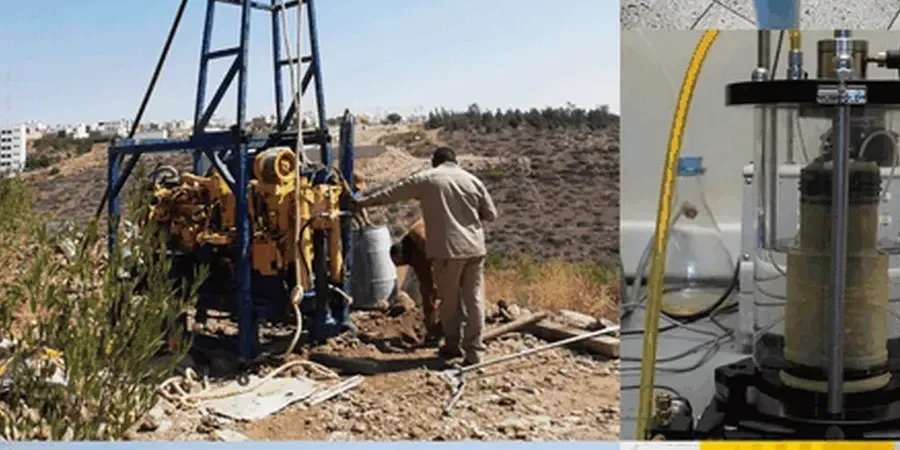
The split-spoon sampler drives into the ground at 30 blows per foot, and immediately you know—this is Boston blue clay. Our field crews work with rotary rigs and thin-wall Shelby tubes across the city, from Back Bay to the Seaport, pulling undisturbed samples that tell the real story beneath the surface. A proper soil mechanics study in Boston starts with that physical evidence: Atterberg limits, triaxial shear, and one-dimensional consolidation on the very material that has shaped this city's foundation history. We run these tests in our AASHTO-accredited lab, connecting the index properties to the behavioral parameters engineers actually need for design. In Boston's complex glacial stratigraphy, we often pair sampling with CPT testing to capture continuous stratigraphic profiles where the till surface is erratic, and when deep excavations are planned near existing structures, the data feeds directly into excavation monitoring programs to protect adjacent foundations.
Boston blue clay isn't just one material—its behavior changes block by block, and a generic soil mechanics study won't capture the sensitivity that governs excavation stability here.
Site-specific factors
The mistake we see repeatedly in Boston is treating the blue clay as a textbook normally consolidated material and skipping the consolidation testing, then watching settlements double the predicted values within the first year of service. Marine clays in this city carry a depositional history that creates a desiccated crust with apparent overconsolidation; if you sample just the crust and extrapolate downward, you get unconservative settlement estimates that lead to cracked slabs, tilted footings, and expensive underpinning. Another common error is ignoring the groundwater regime: perched water tables in the outwash lenses are routine, and effective stress calculations that assume a single hydrostatic profile from the Charles River level will underestimate pore pressures in excavations. A rigorous soil mechanics study in Boston must include staged consolidation tests, careful identification of preconsolidation pressure via Casagrande or strain-energy methods, and site-specific piezometric monitoring to feed realistic parameters into the settlement and stability models.
Questions and answers
What laboratory tests are essential for a soil mechanics study in Boston's glacial soils?
For Boston's typical profile, the essential suite includes Atterberg limits and grain size distribution for classification, one-dimensional consolidation tests on the clay layers to determine compression and recompression indices plus preconsolidation pressure, and consolidated-undrained triaxial tests with pore pressure measurement to establish the effective stress shear strength parameters. We also run natural moisture content on every sample because the water content profile helps identify the transition from the desiccated crust into the normally consolidated zone—a boundary that controls settlement calculations.
How do you handle sampling disturbance in sensitive Boston blue clay?
Sampling disturbance is a real issue with sensitive marine clays. We use thin-wall Shelby tubes with an area ratio below 10% and transport samples in cushioned carriers to minimize vibration. In the lab, we trim specimens carefully and let them reconsolidate under in-situ stress before shear. We also run unconfined compression tests on selected specimens and compare the unconfined strength to the triaxial undrained strength; a ratio below 0.5 typically indicates disturbance, and we flag those samples in the report so the designer can apply judgment to the parameters.
What is the typical cost range for a soil mechanics study in the Boston area?
For a comprehensive soil mechanics study in Boston—including classification tests, consolidation, and triaxial shear on samples from a medium-sized project—the cost generally falls between US$3.050 and US$5.550, depending on the number of samples, the specific tests requested, and the turnaround time. Complex projects requiring multiple triaxial stages or special consolidation protocols can push toward the upper end.
How long does it take to get results from consolidation and triaxial tests?
Consolidation tests are inherently time-consuming because each load increment must reach at least primary consolidation before we move to the next step; a standard incremental loading test typically takes 5 to 10 days per specimen. Triaxial shear tests are faster—usually 2 to 4 days per specimen including saturation, consolidation, and shear stages. We can expedite with overlapping specimen setups, but we do not compromise the consolidation increments because cutting them short produces unconservative settlement parameters that no amount of calculation can fix.
Can you perform a soil mechanics study on samples we already have stored?
Yes, we can test stored samples provided they have been kept in sealed, moisture-tight containers and have not dried out or been subjected to freezing temperatures. We will first assess the sample condition with a visual inspection and a remolded strength check; if the material is still representative, we proceed with the requested testing. For samples older than 6 months, we recommend confirming that the moisture content has not changed significantly before committing to a full laboratory program.