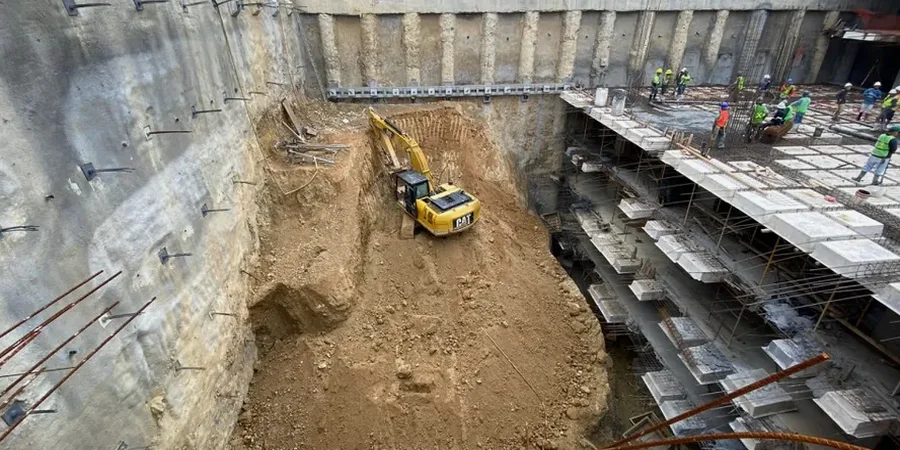
Boston's skyline didn't just rise; it was carved out of glacial geology. From the original Shawmut Peninsula to the massive landfill projects of the 19th century that created the Back Bay and much of the modern waterfront, this city is built on a patchwork of natural deposits and historical fill. Designing a deep excavation here means confronting Boston blue clay, dense till, and unpredictable urban debris within a single site footprint. A proper geotechnical design isn't a commodity; it's the only thing standing between a successful foundation and a multimillion-dollar legal claim when an adjacent 19th-century masonry building starts to settle. Before shoring design begins on a downtown project, we typically combine our soil characterization with a CPT test to precisely delineate the clay strata and identify loose zones in the fill without disturbing the sensitive marine clay structure.
In Boston's organic clay deposits, an excavation's factor of safety against basal heave is often more critical than structural steel design.
Site-specific factors
The risk profile for a deep excavation in the Back Bay versus Beacon Hill couldn't be more different. In the Back Bay, founded on artificial fill over deep organic silt and clay, the primary risk is regional subsidence. Extracting groundwater from an excavation can trigger consolidation in the compressible clay layer, causing block-wide settlement that damages historic brownstones a hundred yards away. On Beacon Hill, however, the risk shifts to vibration-induced damage and rockfall as you blast or hammer into the Cambridge Argillite. The unpredictable nature of the urban fill—which can contain buried timber piles, granite blocks, and old seawalls—creates a secondary risk of obstructions that standard drilling methods cannot penetrate. An empirical approach using local case histories and solid observational methods is non-negotiable to avoid catastrophic lateral wall movements during preload removal.
Questions and answers
What specific challenges does the Boston Blue Clay pose for deep excavation design?
The Boston Blue Clay is a sensitive, normally to lightly overconsolidated marine clay with a high undrained shear strength that degrades significantly under cyclic loading or large strains. This strain-softening behavior means a stable cut can rapidly deteriorate if deformations are not tightly controlled. We use advanced finite element analysis (PLAXIS or FLAC) with user-defined soil models to capture the small-strain stiffness and progressive failure mechanisms that simpler limit-equilibrium methods often miss.
Do you handle the permitting process with the Boston Groundwater Trust?
Yes. Any project requiring dewatering or permanent groundwater cutoff structures in the downtown overlay district must comply with the Groundwater Conservation Overlay District (GCOD) regulations. We prepare the required hydrogeologic reports, demonstrating that the proposed excavation support system will not permanently lower the groundwater table, which is critical for preserving the timber pile foundations of adjacent historic structures.
What is the typical cost range for a geotechnical deep excavation design in Boston?
For a typical urban project in Boston, the geotechnical engineering design for the excavation support system ranges from US$2,360 for a limited scope shoring review to US$9,600 for a full design package on a complex, multi-level excavation. The final fee depends on the depth of the cut, proximity to sensitive structures, and whether a finite element analysis is required for the Groundwater Trust submission.
How do you account for the historical fill when designing a tieback system?
Designing tiebacks in historical fill requires a cautious approach. We assume a high potential for obstructions and specify a sacrificial pre-drilling process through the fill layer. Our designs use a lower grout-to-ground bond stress in the fill zone, typically neglecting it entirely for capacity calculations, and we require proof testing on every production anchor installed through the fill to verify the bond length in the underlying competent soil.