← Home · Laboratory

Laboratory CBR Testing in Boston – Pavement Design Parameters

Together, we solve the challenges of tomorrow.

LEARN MORE →

A recent I-93 widening project near South Bay encountered silty subgrade with CBR values below 3%. The contractor faced potential pavement failure before the first winter freeze-thaw cycle. Boston's glacial till and marine clay deposits rarely behave as the boring logs predict. Our lab runs the California Bearing Ratio test under controlled moisture and density conditions—soaked for worst-case spring thaw scenarios, unsoaked for construction-phase verification. The piston penetration curve tells you exactly how the compacted fill will perform under wheel loads. We pair this with Proctor compaction tests to lock in the moisture-density relationship before CBR specimen preparation, and with grain-size analysis when fines content may control drainage behavior under the pavement section.

A CBR of 6% means the subgrade supports one-tenth the load of crushed stone—get this number wrong and the asphalt cracks in two seasons.

Process and scope

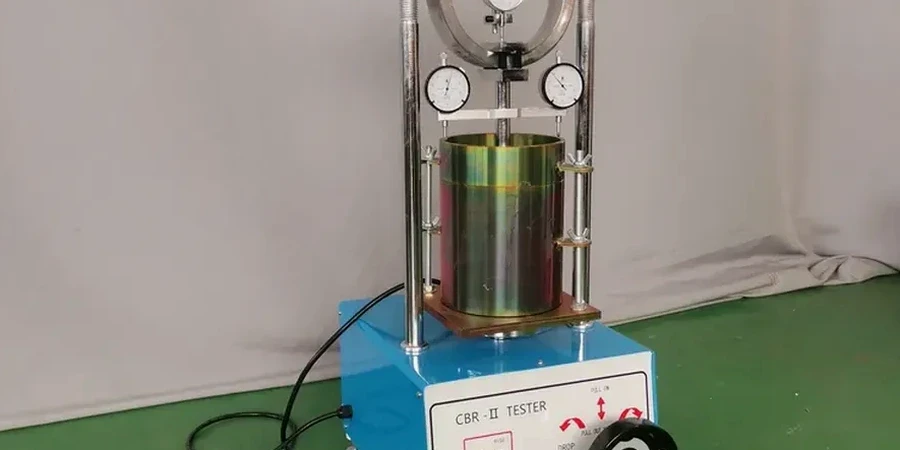
The test frame applies a 0.05 in/min penetration rate through a 1.95-in diameter piston into a 6-inch compacted specimen. A surcharge ring simulates the overlying pavement weight—typically 10 lb for flexible sections. The load-penetration curve is corrected for surface irregularities, then normalized against standard crushed stone values at 0.1 and 0.2 inches. Boston-area projects often require soaked CBR after 96-hour immersion, reflecting groundwater conditions in Back Bay fill. We measure swell percentage concurrently. For granular base course materials, the in-situ density verification provides the field compaction benchmark that ties directly to lab-derived CBR design values. When the subgrade is marginal, we may recommend a flexible pavement section with thicker aggregate base to bridge weak zones.
Laboratory CBR Testing in Boston – Pavement Design Parameters
Technical reference image — Boston

Site-specific factors

Boston winters punish pavement sections that ignore soaked CBR values. A subgrade compacted dry in August can lose 40% of its bearing capacity by March after freeze-thaw cycling saturates the fines. We've seen projects in Dorchester and Roxbury where unsoaked CBR hit 12% but soaked dropped to 4%—the difference between a 4-inch and an 8-inch asphalt section. The MassDOT design manual requires soaked values for all permanent roadways. Ignoring swell measurement is another hazard: clay subgrades with 3% swell can heave the pavement enough to create longitudinal cracking along the wheel paths. Combustion-prone organic silts in filled areas of the Charles River basin need careful specimen preparation to avoid misleading results.

Need a geotechnical assessment?

Reply within 24h.

Email: contact@geotechnical-engineering.vip

Technical data

ParameterTypical value
StandardAASHTO T-193 / ASTM D1883
Specimen diameter6.0 in (152.4 mm)
Piston diameter1.95 in (49.6 mm)
Penetration rate0.05 in/min (1.27 mm/min)
Soaking period (standard)96 hours submerged
Surcharge weight10–20 lb (flexible vs. rigid)
Material suitabilityMax particle size < 3/4 in

Complementary services

01

Soaked CBR Program

96-hour immersion with swell measurement. Specimens compacted at optimum moisture per AASHTO T-99. We deliver corrected CBR at 0.1 and 0.2 in penetration, plus the full stress-penetration curve for pavement design software input.

02

Unsoaked CBR for Construction Control

Rapid turnaround for field compaction verification during subgrade preparation. Tests at received moisture content. We report CBR within 48 hours so the earthwork contractor can adjust rolling patterns before the next lift.

Relevant standards

AASHTO T-193: Standard Method of Test for CBR of Laboratory-Compacted Soils, ASTM D1883: Standard Test Method for CBR of Laboratory-Compacted Soils, ASTM D698 / AASHTO T-99: Standard Proctor (reference compaction), MassDOT Standard Specifications for Highways and Bridges, Division 100

Questions and answers

What CBR value does MassDOT require for subgrade?

MassDOT specifications typically require a minimum soaked CBR of 6% for subgrade under flexible pavements. Values below 3% mandate subgrade stabilization or removal and replacement with select borrow. The exact threshold depends on traffic loading and the pavement design catalog section being used.

How long does a laboratory CBR test take?

An unsoaked CBR test can be reported in 24-48 hours. A soaked CBR test requires 96 hours of immersion plus specimen preparation and testing time, typically delivering results in 5-6 working days from sample receipt.

Do you need undisturbed or remolded samples for CBR?

The laboratory CBR test uses remolded specimens compacted at a specified moisture content and density. We need approximately 50 lb of disturbed soil per material type. The sample should be representative of the subgrade or borrow source.

How much does a CBR test cost in the Boston area?

Laboratory CBR testing typically ranges from US$140 to US$200 per specimen, depending on whether soaked or unsoaked conditions are required and the number of compaction points specified. Volume pricing applies for projects requiring five or more specimens.
Location and service area

We serve projects across Boston and surrounding areas.

View larger map