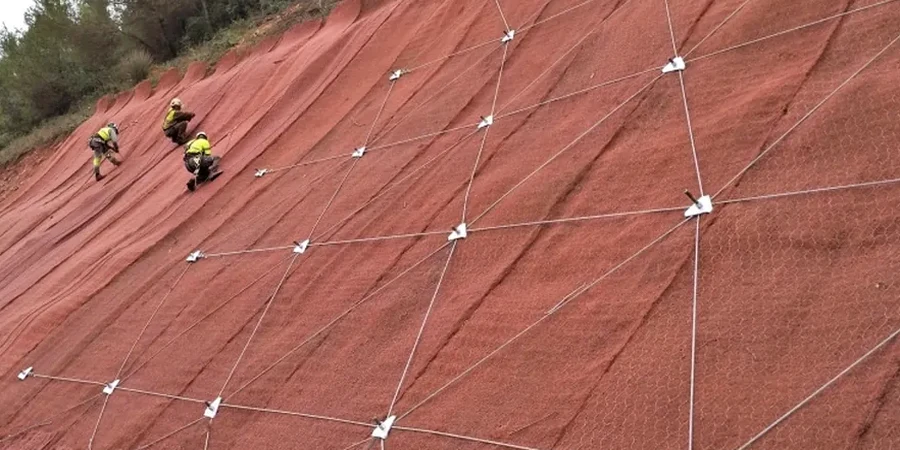
Boston's topography wasn't always defined by the flat Back Bay and high-rise towers. The original Shawmut Peninsula was a drumlin field, and as the city expanded through massive landfill projects in the 19th century, engineers created a patchwork of artificial ground over marine clay and glacial till. Building on or near these slopes—whether in West Roxbury's puddingstone ledges or along the Neponset River embankments—requires a rigorous understanding of how these mixed soils behave under load and saturation. A superficial walkover won't catch the deep-seated failure planes that form in the underlying Boston blue clay. Our slope stability analysis combines site-specific stratigraphy with limit equilibrium methods to quantify the factor of safety against rotational and translational slides. For projects near the harborfront, we often pair this with an in-situ permeability test to model how tidal fluctuations affect pore water pressure behind the slope face.
In Boston's made land, the difference between a stable slope and a failure is often the drainage detail nobody thought to draw on the plans.
Questions and answers
What does a slope stability analysis cost for a typical Boston residential or commercial project?
For a site-specific analysis including soil borings, lab testing, and the engineering report, the cost typically ranges from US$1,100 to US$3,810. The final fee depends on the slope height, the complexity of the subsurface profile, and whether seismic analysis is required. A small residential cut in West Roxbury will be at the lower end, while a multi-story excavation in the Back Bay with adjacent historic structures and tieback design will push toward the upper range.
How does the Boston building department review slope stability reports?
The Inspectional Services Department (ISD) reviews geotechnical submittals against the Massachusetts State Building Code, which adopts IBC Chapter 18. They require a Massachusetts-registered Professional Engineer's stamp on all stability analyses. For projects involving cuts over ten feet or within the seismic design category D, the ISD expects explicit documentation of the factor of safety, the groundwater assumptions, and the construction monitoring plan before issuing a foundation permit.
Can you analyze a slope that already shows signs of cracking or movement?
Yes, forensic stability analysis is a core part of our practice. We install slope inclinometers to measure the depth and rate of movement, then back-analyze the failure to determine the in-situ shear strength of the soil. That calibrated model lets us design a remediation—often a combination of regrading, drainage improvements, and structural reinforcement like soil nails—that brings the slope back to a code-compliant factor of safety.