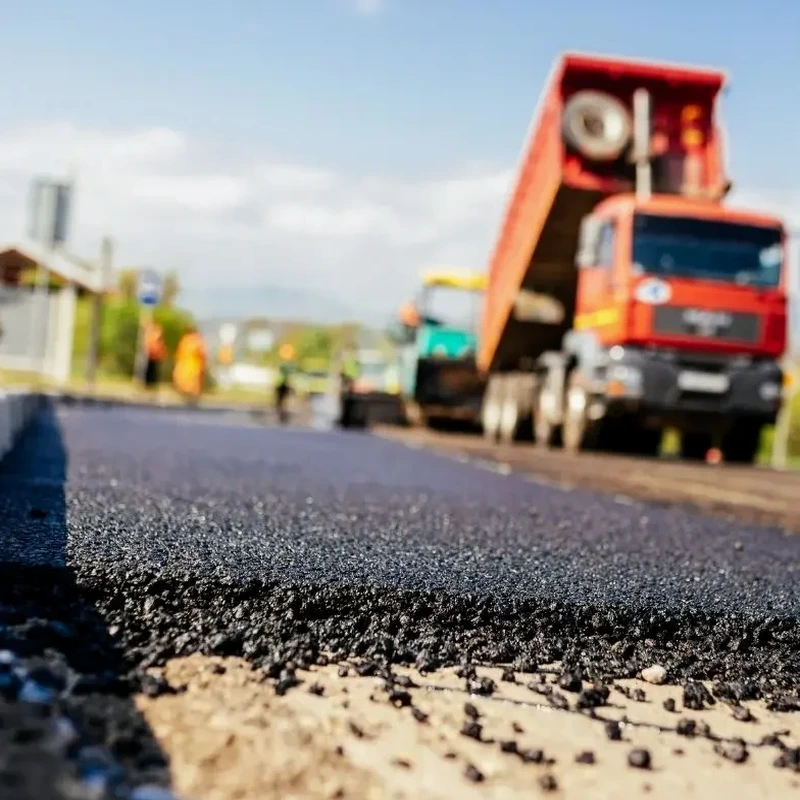
Boston sits at an elevation of just 46 feet above sea level, much of it built on filled land that was once tidal marsh. Every road, parking lot, and arterial in the city contends with a subsurface that shifts from dense glacial till to compressible organic silts within a few hundred feet. A pavement structure designed without accounting for this variability will rut, crack, and fail well before its design life. The flexible pavement design process we follow integrates subgrade characterization under AASHTO 93, with layer coefficients calibrated to local aggregates and binder performance grades suited to New England winters. Whether for a new development in the Seaport or a reconstruction in Dorchester, the pavement section must handle not just traffic loads but also the freeze-thaw cycles that heave poorly drained bases. The CBR testing for roads data is often the starting point, establishing the resilient modulus input that drives the entire structural number calculation.
A pavement section that works in Phoenix won’t survive two winters in Boston without proper subgrade treatment and drainage design.
Process and scope
Boston’s geology is dominated by the Boston Basin, underlain by Cambridge Argillite and Roxbury Conglomerate bedrock, but the near-surface materials are overwhelmingly glacial: dense lodgement till, outwash sands, and the notorious Boston Blue Clay in low-lying areas. This clay, with undrained shear strengths sometimes below 500 psf, presents a subgrade challenge that cannot be resolved with a thicker asphalt mat alone. Flexible pavement design here demands a mechanistic-empirical approach: we compute tensile strain at the bottom of the asphalt layer and compressive strain on top of the subgrade, then compare against transfer functions calibrated to regional performance data. Drainage coefficients are adjusted for Massachusetts’ annual precipitation of 48 inches. Granular base materials are specified with permeability targets that prevent saturation during the spring thaw, when frost leaves the ground and the pavement is most vulnerable to load-induced distress.
Site-specific factors
The difference between a pavement built in Back Bay versus one in West Roxbury is stark. Back Bay sits on filled land with a high water table; the subgrade is often saturated marine clay that loses strength dramatically when remolded. West Roxbury, by contrast, rests on glacial till with excellent drainage and high bearing capacity. Applying the same pavement section to both sites would be a costly mistake: the Back Bay road would rut within five years, while the West Roxbury road would be overbuilt and wasteful. The primary risks in Boston include differential frost heave across transitions from cut to fill, stripping of the asphalt binder from aggregates in poorly drained bases, and subgrade softening during the spring thaw. Each requires a specific design countermeasure: underdrains, capillary breaks, stabilized subbase layers, or geotextile separators that prevent fines migration into the open-graded base.
Relevant standards
AASHTO Guide for Design of Pavement Structures (1993), with Massachusetts Supplement, ASTM D1883-21 (CBR) and ASTM D1557-12e1 (Modified Proctor), MassDOT Standard Specifications, Section 401 (Hot Mix Asphalt) and Section 402 (Warm Mix Asphalt), NCHRP 1-37A (MEPDG) for mechanistic-empirical calibration
Questions and answers
What is the typical design life for a flexible pavement in Boston?
Most municipal and MassDOT projects target a 20-year structural design life for flexible pavements, with a functional overlay anticipated at year 12 to 15. The design traffic in equivalent single axle loads (ESALs) is projected over 20 years using growth rates from the Boston Region MPO. Perpetual pavement designs, which use a thicker asphalt layer to keep tensile strains below the fatigue endurance limit, can extend the structural life beyond 50 years with only surface renewal.
How does the Boston Blue Clay affect pavement design?
Boston Blue Clay is a marine illitic clay with low undrained shear strength and high compressibility. Under repeated traffic loading, it can accumulate plastic strain and cause rutting if the pavement section is too thin. The solution usually involves either a thicker granular base to distribute load, chemical stabilization with lime or cement to increase the subgrade modulus, or partial removal and replacement with structural fill. The design must also account for the clay’s low permeability by incorporating drainage layers that prevent water from ponding at the subgrade interface.
What does flexible pavement design cost for a typical Boston commercial project?
The engineering fee for a flexible pavement design package, including subgrade investigation, traffic analysis, layer thickness calculations, and construction specifications, ranges from US$1,550 to US$5,780 depending on project size and traffic complexity. A small parking lot with low ESALs falls at the lower end; a high-volume arterial with mechanistic-empirical calibration and seasonal adjustment factors is at the upper end.