← Home · Slopes & Walls

Active and Passive Anchor Design in Boston — Tiebacks and Soil Nails

Together, we solve the challenges of tomorrow.

LEARN MORE →

In Boston, we often see engineers underestimate how the city's complex glacial stratigraphy complicates anchor bond zones. Designing a tieback that crosses from granular outwash into Boston Blue Clay without a deliberate transition zone is a recipe for creep. Our design team approaches every anchor calculation by first mapping the subsurface with CPT testing to define continuous stratigraphy, because relying solely on SPT blow counts in interbedded deposits masks the true stiffness contrast. We then match the anchor type — active prestressed tendons for basement shoring, or passive fully-grouted bars for slope stabilization in Roxbury Puddingstone — to the ground behavior. The urban context adds further constraints: we routinely check for underground utilities with resistivity surveys before establishing the anchor inclination, since hitting a century-old brick sewer under Tremont Street is far more costly than adding an extra day of investigation.

A well-designed anchor transfers load to competent ground without pulling the street above into the excavation — in Boston's tight urban grid, that margin is often less than three feet.

Process and scope

Anchor behavior varies dramatically between the Back Bay and the outlying suburbs. In the filled tidelands of Back Bay, where organic silt and undocumented timber piles still underpin many historic facades, we typically design active strand anchors with double corrosion protection and load cells to confirm that prestress isn't bleeding off into compressible layers. Conversely, in the glacial hardpan of Newton or Weston — dense till with cobbles and boulders — passive hollow-bar anchors installed with rotary-percussive drilling often achieve higher bond stresses than predicted by FHWA guidelines, because the till matrix interlocks around the grout column. We verify this directly via pullout tests on sacrificial anchors, comparing results to FHWA-NHI-05 methodology. For temporary excavation support adjacent to MBTA infrastructure, we integrate the anchor design with a deep excavation monitoring program, so that any unexpected load redistribution triggers a review before the next bench is cut.
Active and Passive Anchor Design in Boston — Tiebacks and Soil Nails
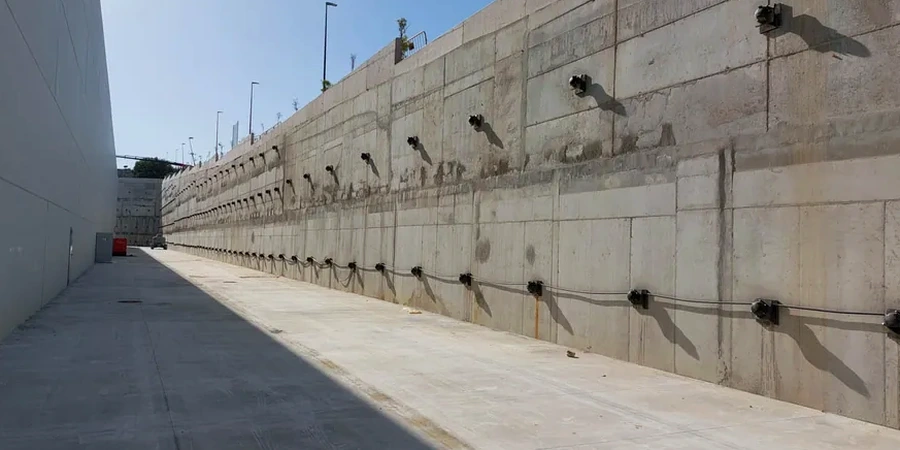
Technical reference image — Boston

Site-specific factors

A 40-ton excavator with a Klemm 806 drill mast is a common sight on Boston's constrained infill lots, where the mast must be articulated to drill anchors beneath overhead power lines and within inches of party walls. The primary risk is loss of ground during drilling through running sands of the outwash plain; without a duplex casing system advancing simultaneously with the bit, uncontrolled soil extraction can rapidly create a void that propagates upward into the adjacent roadway. We mitigate this by specifying external flush casing and maintaining positive grout pressure during extraction. A second failure mode we encounter is progressive debonding in Boston Blue Clay when bond stress assumptions exceed the drained shear strength — we limit bond stress to 0.15 times the undrained shear strength measured via field vane tests, which is more conservative than default FHWA tables but has proven reliable across dozens of projects in the Fort Point Channel area.

Need a geotechnical assessment?

Reply within 24h.

Email: contact@geotechnical-engineering.vip

Technical data

ParameterTypical value
Anchor typeActive (prestressed) and passive (soil nails)
Applicable standardPTI DC35.1-14, FHWA-NHI-05
Corrosion protectionClass I (double protection) for permanent
Bond length verificationPre-production pullout tests
Design load range15 to 150 kips per strand tendon
Drilling methodRotary-percussive with duplex casing
Proof testing133% of design load per PTI
Typical inclination15° to 45° below horizontal

Complementary services

01

Prestressed Tieback Design

Active anchors for soldier pile and secant wall support in deep basements. We design multi-strand tendons with full-scale performance testing per PTI DC35.1, including lift-off tests to confirm lock-off load after wedge set.

02

Passive Soil Nail Walls

Top-down nailed excavation support for cut slopes and highway widening. We specify sacrificial pullout tests at the start of construction to calibrate bond stress in Boston's glacial tills before production drilling begins.

03

Rock Anchor Systems

Anchors bonded into Roxbury Puddingstone or Cambridge Argillite for transmission tower foundations and retaining wall tie-downs. We design with water-cement ratios below 0.45 and staged grouting to ensure bond integrity in fractured bedrock.

Relevant standards

PTI DC35.1-14 Recommendations for Prestressed Rock and Soil Anchors, FHWA-NHI-05-037 Soil Nail Walls, AASHTO LRFD Bridge Design Specifications, Section 11, MassDOT Geotechnical Engineering Manual

Questions and answers

What distinguishes an active anchor from a passive anchor in Boston's typical excavation support?

Active anchors are prestressed after grout curing, applying a controlled force to the wall before any excavation-induced movement occurs — this is essential for limiting lateral deformation beneath sensitive abutting structures in Boston's dense neighborhoods. Passive anchors, such as soil nails, only engage in tension when the soil mass begins to deform, making them suitable for cut slopes where some movement is tolerable and where incremental top-down installation aligns with the excavation sequence.

How much does anchor design and testing cost for a typical Boston basement excavation?

For a single-family or small commercial basement in Boston, the combined design, submittal, and on-site testing scope typically falls between US$930 and US$3.740, depending on the number of anchor rows, the complexity of the subsurface profile, and whether pre-production pullout tests are required to confirm bond stress assumptions in variable glacial soils.

Do Boston's building authorities require specific anchor testing protocols?

Yes. The Boston Inspectional Services Department and MassDOT both enforce proof testing and performance testing per PTI DC35.1 or FHWA-NHI-05, with extended creep tests required when anchors are bonded in cohesive soils like Boston Blue Clay. We coordinate the testing schedule with the special inspector and provide the engineer's certification for each anchor row before the next excavation lift proceeds.
Location and service area

We serve projects across Boston and surrounding areas.

View larger map