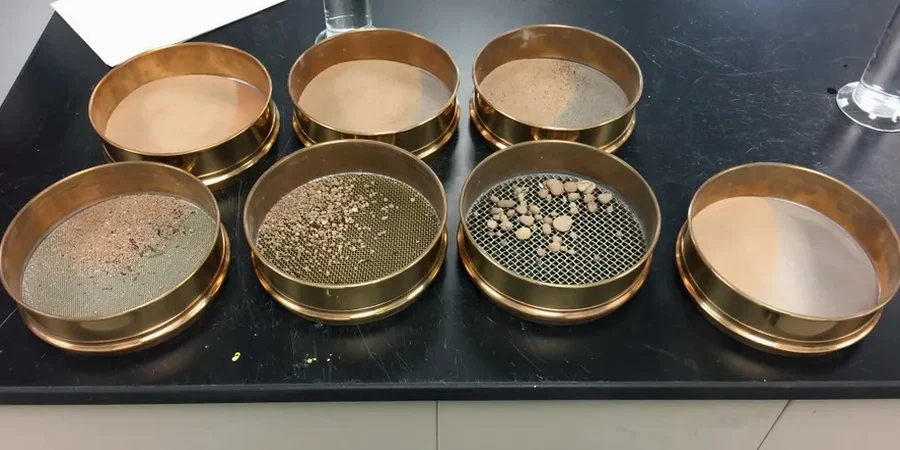
Boston sits on a mess of glacial till, outwash, and the infamous Boston blue clay. The geotechnical picture changes block by block — the Back Bay is fill, Beacon Hill is ledge, and the Seaport sits on compressible marine deposits. Getting the gradation right is not academic here; it directly drives settlement predictions, drainage design, and whether your excavation shoring holds. A combined sieve and hydrometer analysis (ASTM D6913 and ASTM D7928) gives you the full curve from gravel down to colloidal clay. We run the atterberg limits on the fines fraction when the hydrometer flags sensitive silts, because Boston's low-plasticity silts have tripped up more than one foundation design.
Gradation is not just a lab exercise — in Boston's layered fills and marine clays, the silt-clay split from the hydrometer defines your drainage and settlement assumptions.
Process and scope
A developer we worked with on a multifamily project in Dorchester had fill soils with bricks, ash, and pockets of fine sand. The initial sieve-only report suggested clean sand, but the hydrometer showed 18% passing the No. 200 sieve with a clay fraction that held water. That changed the infiltration design completely. Our lab in the Boston area runs the full stack: wash sieving, mechanical shaking, and hydrometer sedimentation with dispersing agent per ASTM D7928. We classify to USCS per ASTM D2487 and deliver the gradation table, coefficient of uniformity, coefficient of curvature, and the percent gravel-sand-silt-clay breakdown. The report includes the hydrometer correction curve and the combined plot so you can see exactly where the transition happens. For urban sites with historical fill, the hydrometer often reveals fines that the naked eye misses.
Site-specific factors
Boston's development history left a legacy of uncontrolled fill — the Back Bay was literally created by filling tidal marshes in the 19th century, and the Big Dig unearthed soils that no one had characterized before. If you skip the hydrometer and classify a silty sand as clean based on a quick sieve, you risk overestimating permeability by an order of magnitude. That leads to undersized drainage systems, unexpected pore pressure buildup, or retaining walls designed without accounting for the real fine content. In seismic terms, fines content is a direct input into liquefaction susceptibility per the Youd-Idriss framework. Boston's moderate seismicity, coupled with loose saturated fills, makes the silt-clay cutoff a safety-critical parameter.
Questions and answers
How much does a combined sieve and hydrometer test cost in Boston?
For projects in the Boston area, a combined ASTM D6913 + D7928 analysis typically runs between US$100 and US$170 per sample, depending on the number of samples and whether you need rush turnaround. We can give you a firm quote once we know the sample count and soil type.
How long does the hydrometer test take?
The sedimentation readings run over a minimum 24-hour period per ASTM D7928, plus sample preparation and oven-drying. Standard lab turnaround is 3 to 5 business days. If you are up against a submission deadline, we do offer an expedited schedule — let us know when you send the samples in.
Do I really need the hydrometer for Boston blue clay?
Yes, and here is why: Boston blue clay is not 100% clay. It often contains silt partings and fine sand lenses that affect shear strength and consolidation behavior. The hydrometer gives you the real clay fraction, which controls plasticity, swell potential, and time rate of settlement. A sieve alone misses all of that.