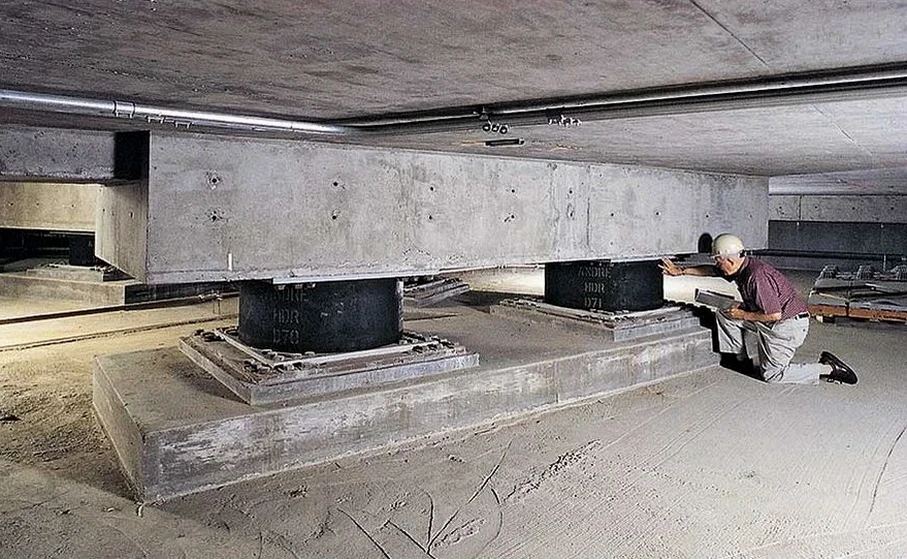
Boston's seismic reality is shaped by more than just the rare New England earthquake—it is defined by the glacial legacy beneath every foundation. The dense till, marine clay pockets, and filled land that make up much of the city's subsurface create a complex amplification pattern that standard fixed-base design often underestimates. When a structure sits on Back Bay fill or the compressible organic silts near the Charles River estuary, the spectral acceleration demands can shift dramatically, and that is precisely where a properly calibrated base isolation seismic design becomes essential. By decoupling the superstructure from ground motion using elastomeric or friction pendulum bearings, we help engineering teams meet the performance objectives of ASCE 7 Chapter 17 while accounting for Boston's notoriously variable depth-to-refusal. The process begins with a thorough VS30 characterization—often through MASW and downhole testing—to define the site class before any isolator properties are selected, because a Site Class E profile in South Boston demands a fundamentally different isolation strategy than the bedrock-controlled Class B sites in Roxbury.
A base isolation system in Boston is only as reliable as the ground characterization beneath it—without site-specific modulus degradation curves, the bearing displacement estimates can be off by 30% or more.
Process and scope
Decades of local investigation have taught us that Boston's most challenging isolation projects are rarely on clean rock. The city's geological history—Pleistocene glaciation followed by Holocene sea-level rise—left behind layers that can shift from stiff lodgement till to soft Boston Blue Clay within a few vertical meters, a transition that fundamentally alters the dynamic stiffness input for the isolation interface. Our laboratory supports the design workflow by running cyclic triaxial tests on undisturbed clay specimens to quantify modulus degradation curves, and resonant column tests to capture the small-strain shear modulus that governs wave propagation through the upper 30 meters. The nonlinear backbone curves derived from these tests feed directly into the time-history analyses used to validate bearing displacement demands under the Maximum Considered Earthquake. For structures in the Seaport District, where artificial fill overlies compressible marine deposits, we often recommend supplemental dampers to control the displacement envelope without excessive isolator dimensions, a pragmatic approach that has proven cost-effective across multiple Boston projects. The interplay between soil-structure interaction and isolation system response is not an academic exercise here—it is a daily design reality.
Site-specific factors
A base isolation project that skips the site-specific geotechnical investigation inherits a risk profile that compounds with each design iteration. The loading on the isolation interface is governed by the vertical distribution of shear wave velocity, and when that distribution is inferred from generic correlations rather than measured VS30 data, the resulting ground motion characterization can misrepresent both the spectral shape and the duration of shaking. In Boston, where the depth to the glacial till varies by tens of meters across a single city block, using a default Site Class D assumption for a location that actually exhibits Site Class E behavior leads to underestimated isolator displacement demands—and that underestimation propagates directly into bearing stability, moat wall clearance, and utility connections. Our geotechnical team addresses this by executing a phased characterization program that starts with surface-wave testing and progresses to borehole-based suspension logging when the isolation design enters the detailed phase. The output is a defensible site-specific response spectrum that stands up to peer review, which ASCE 7 mandates for all isolated structures regardless of risk category.
Relevant standards
ASCE 7-22 (Minimum Design Loads, Chapter 17: Seismic Isolation), ASCE/SEI 41-17 (Seismic Evaluation and Retrofit of Existing Buildings), AASHTO Guide Specifications for Seismic Isolation Design (bridges), NEHRP Recommended Provisions (site classification and ground motions), ASTM D7400-19 (Downhole Seismic Testing)
Questions and answers
What is the typical cost range for base isolation seismic design services in Boston?
For projects in the Boston area, the geotechnical and seismic hazard characterization portion of a base isolation design typically ranges from US$4.280 to US$8.730, depending on the number of borings, the depth of the suspension logging campaign, and the complexity of the laboratory testing program. This covers the VS30 profiling, cyclic triaxial and resonant column testing, site response analysis, and the preparation of the ground motion package for time-history analysis. The structural design of the isolators themselves is a separate scope.
Which ASCE 7 provisions govern the isolation design process?
Chapter 17 of ASCE 7-22 covers the seismic design requirements for structures with seismic isolation, including the definition of the Design Earthquake (DE) and Maximum Considered Earthquake (MCE) ground motions, the required analysis procedures (equivalent lateral force, response spectrum, and nonlinear time-history), and the peer review mandate in Section 17.3.3. For existing buildings being retrofitted with isolation, ASCE/SEI 41-17 provides the evaluation framework.
How does Boston Blue Clay affect isolator displacement demands?
Boston Blue Clay is a moderately overconsolidated marine clay with a plasticity index typically between 20 and 40%, and its shear modulus degrades significantly at moderate strain levels. When this clay layer is present within the upper 30 meters, it amplifies the spectral acceleration at periods that often coincide with the isolated structural period, which can increase the displacement demand on the bearings by 15-25% compared to a bedrock site condition.
Is peer review mandatory for base-isolated buildings?
Yes. ASCE 7-22 Section 17.3.3 requires an independent peer review for all structures that use seismic isolation, regardless of the risk category. The review panel examines the ground motion selection, the isolator properties, the analysis methodology, and the verification of design displacements. In Boston, we have experience preparing documentation packages that meet the expectations of local peer review boards.