Together, we solve the challenges of tomorrow.
LEARN MORE →In Boston, the category of Slopes & Walls addresses the critical interface between natural terrain, excavations, and the built environment. From the dense urban core of Back Bay to the suburban fringes of Newton and Milton, nearly every construction project contends with grade changes, soil retention, and the inherent instability of the region's geological profile. This discipline encompasses the analysis, design, and remediation of earth slopes and structural retaining systems to prevent landslides, protect adjacent properties, and ensure the long-term integrity of infrastructure. Given Boston's history of glacial activity and its extensive, aging building stock, proper slope and wall engineering is not merely a regulatory checkbox—it is a fundamental necessity for public safety and urban resilience.
Boston's subsurface conditions are dominated by glacial till, marine clays, and artificial fill, particularly in areas like the Seaport District and along the Charles River. The notorious Boston Blue Clay, a marine deposit, presents significant challenges due to its low shear strength and high compressibility, often necessitating specialized slope stability analysis to prevent rotational failures during excavation. Bedrock, primarily Cambridge Argillite and Roxbury Puddingstone, can be shallow in some neighborhoods yet deep in others, creating abrupt transitions that complicate both open-cut and supported excavations. Additionally, the city's high groundwater table, influenced by tidal fluctuations and historic infill of waterways, exerts hydrostatic pressure on retaining structures, demanding robust drainage and waterproofing strategies as part of any wall design.
The regulatory framework governing slopes and walls in Boston is stringent, rooted in the Massachusetts State Building Code (780 CMR), which adopts and amends the International Building Code (IBC). Chapter 18 of the code specifically addresses soils and foundations, requiring geotechnical investigations for any structure supported by or retaining earth. For retaining walls over four feet in height, a professional engineer must design the system to resist lateral earth pressures, surcharge loads, and seismic forces per the code's seismic design category. Boston's Zoning Code and the Massachusetts Environmental Policy Act (MEPA) may trigger additional review for projects near coastal zones or steep slopes, often requiring a retaining wall design that accounts for erosion control and habitat protection. The Boston Groundwater Trust's monitoring network also influences design, as projects must demonstrate they will not lower the groundwater table in a way that could cause settlement to adjacent historic structures.
Projects requiring these services range from single-family home additions on sloping lots in West Roxbury to massive infrastructure ventures like the Big Dig's tunnel approaches. Urban infill developments frequently demand temporary shoring and permanent basement walls, often utilizing active/passive anchor design to support deep excavations without encroaching on neighboring property lines. Institutional campuses, such as those of Harvard and MIT, routinely undertake complex slope stabilization for parking structures built into hillsides or for retaining walls along pedestrian corridors. Transportation projects, including MBTA station expansions and roadway widenings, rely on reinforced soil slopes and mechanically stabilized earth walls to maximize usable land in constrained corridors. Each project type demands a tailored approach that balances structural demands with Boston's unique subsurface and regulatory landscape.
Common failure modes include rotational slides in Boston Blue Clay due to its low shear strength, translational failures along fill-bedrock interfaces, and overturning or sliding of gravity walls from excessive hydrostatic pressure. Freeze-thaw cycles can also degrade soil nails and facing elements over time. Proper drainage design and a thorough slope stability analysis are critical to mitigating these risks.
Under 780 CMR, a building permit is typically required for retaining walls supporting more than four feet of unbalanced fill, or any wall supporting a surcharge such as a building or roadway. The design must be sealed by a Massachusetts-registered Professional Engineer, with geotechnical reports submitted to the local building department for review.
Boston's high groundwater table, influenced by historic landfilling and tidal patterns, exerts significant hydrostatic pressure behind walls and reduces effective stress in slopes. Designs must incorporate weep holes, drainage blankets, or mechanical dewatering systems. Projects near the coast must also address saltwater corrosion potential on tieback anchors and reinforcement.
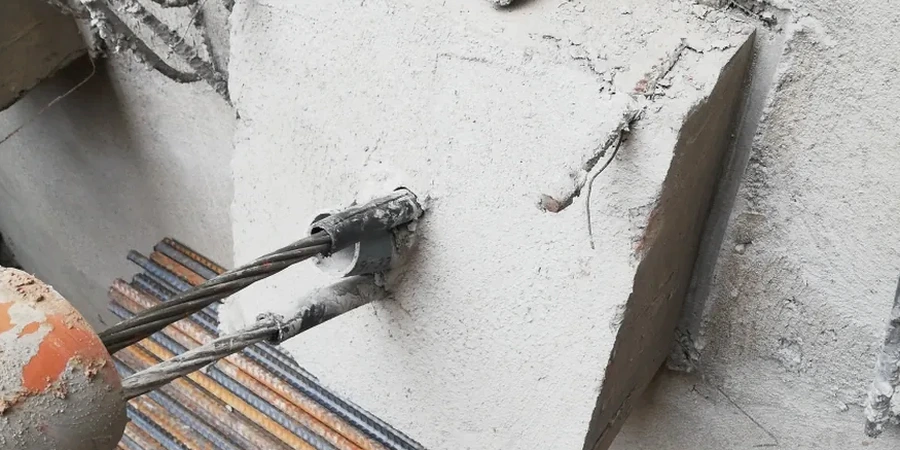
Active anchors are post-tensioned after installation to immediately apply a pre-determined load to the wall, controlling deflection from the outset. Passive anchors, such as grouted soil nails, develop resistance only as the soil mass deforms. The choice depends on allowable movement, soil conditions, and proximity to adjacent structures, with active/passive anchor design tailored to each project's specific performance criteria.