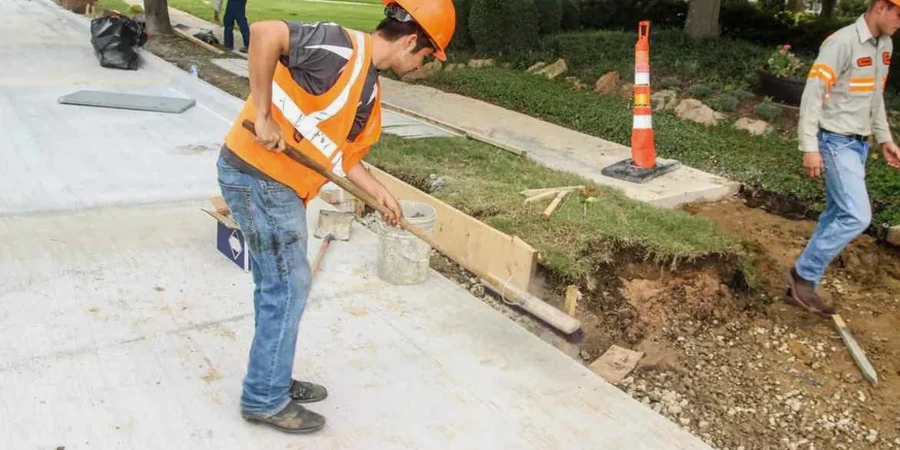
Boston recorded over 50 freeze-thaw cycles in the 2022–2023 winter alone. That statistic drives every rigid pavement design we produce in the city. Portland cement concrete slabs expand, contract, and curl under thermal stress—and on a subgrade that often transitions from dense glacial till to compressible Boston blue clay within a few hundred feet, the slab needs more than just thickness. It needs a joint plan that accounts for the city's historic street geometries and a base layer that drains. Our team applies ACI 330R-08 and the MassDOT Pavement Design Manual to deliver jointed plain concrete pavements that hold up under bus rapid transit lanes, loading docks, and the daily grind of Mass Pike traffic. For projects where the subgrade stiffness is uncertain, we often pair the rigid pavement scope with a CBR road study to calibrate the k-value before finalizing slab dimensions.
A rigid pavement in Boston isn't just a concrete slab—it's a thermal joint system that must survive 50+ freeze-thaw cycles each winter without spalling or faulting.
Site-specific factors
MassDOT specification Section 701 governs rigid pavement construction in Boston, and it explicitly requires air-entrained concrete with a maximum water-cement ratio of 0.45 for freeze-thaw exposure. Ignore that, and the first winter will spall the surface. The bigger risk sits below the slab. Boston blue clay loses strength when saturated, and if the subbase traps water, pumping and faulting appear at the joints within two years. We see it repeatedly in the Seaport District, where the groundwater table sits just four to six feet below grade. A positive drainage path under the slab matters more than an extra inch of concrete thickness. Our designs always include an open-graded drainage layer and edge drains tied to the stormwater system. On sites with historic fill, we also run a chemical analysis for sulfate attack potential before specifying the cement type.
Questions and answers
What does rigid pavement design cost for a Boston project?
Engineering fees for a standalone rigid pavement design package in the Boston area typically range from US$2,120 to US$5,860, depending on the paved area, number of joint details required, and whether subgrade testing is included. Projects with complex phasing or multiple loading conditions fall toward the upper end.
How do you handle joint design for Boston's freeze-thaw climate?
We specify dowel bars at all transverse contraction joints to maintain load transfer when slabs curl from temperature gradients. Joint spacing follows the 24× thickness rule, and we seal all joints with silicone sealant to prevent water infiltration. For longitudinal joints, tie bars keep lanes from separating.
Can rigid pavement be designed over Boston blue clay?
Yes, but it requires careful subgrade treatment. We typically undercut the upper two to three feet of compressible clay, replace it with crushed stone compacted in lifts, and install a separation geotextile. The k-value improvement is verified with plate load testing before slab design proceeds.