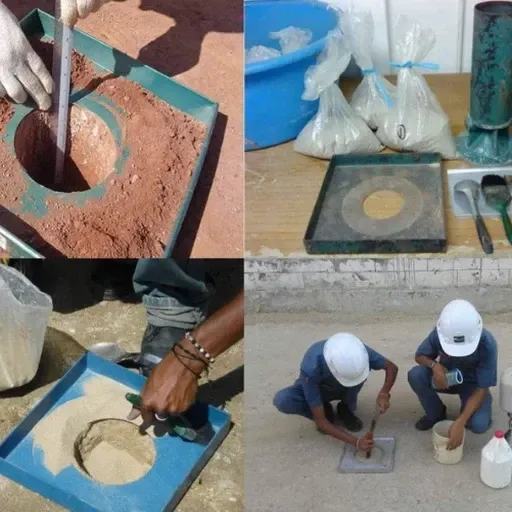
A few winters back, we were called to a mixed-use development off Atlantic Avenue where the structural fill beneath a five-story steel frame had just been placed during a late January cold snap. The spec called for 95% modified Proctor density, but the first three nuke gauge readings were erratic—frozen crust, saturated fines, and a buried utility trench that nobody had logged. We switched to the sand cone method under ASTM D1556, working in 20-minute windows between snow squalls. The numbers told a very different story: the top 6 inches were meeting spec, but the underlying lift had been placed on frozen subgrade and never properly recompacted. That discovery alone saved the owner from a future differential settlement case. In Boston, where glacial till, marine clay, and urban fill intermingle unpredictably, the sand cone test remains the definitive field density measurement for compaction verification.
In Boston's urban fill environment, a sand cone test doesn't just measure density—it reveals whether the compaction crew is working with the geology or fighting against it.
Site-specific factors
What we routinely see in Boston excavations is that the biggest risk isn't failing a density test—it's passing one on a lift that shouldn't have been accepted. Utility trench backfill along Tremont Street or Cambridge Street often gets compacted in narrow lifts with a jumping jack, then tested immediately. The sand cone result looks fine on paper, but the underlying native soil was disturbed during excavation and never recompacted. Six months later, the asphalt patch over that trench settles 2 inches. The same pattern plays out in building pads: a contractor achieves density on the top lift while the subgrade remains uncompacted, creating a hidden soft layer that will consolidate under the foundation load. Boston's freeze-thaw cycles add another layer of complexity—fill placed and tested in winter can pass density, then lose substantial strength when spring meltwater saturates the mass. Our protocol requires probing the subgrade before testing and documenting the moisture condition of each lift at the time of the sand cone measurement.
Questions and answers
How much does a sand cone density test cost in the Boston area?
Per-test pricing for ASTM D1556 field density measurement in Greater Boston typically ranges from US$100 to US$140, depending on site accessibility, number of tests performed in a single mobilization, and whether the Proctor reference curve is already available or needs to be developed in the lab. Projects requiring off-hours work in Downtown or the Seaport District may incur a shift differential. We recommend bundling tests to reduce mobilization costs—most building pads need a minimum of one test per 2,500 square feet per lift.
Why use the sand cone method instead of a nuclear density gauge?
The sand cone method eliminates the calibration drift, moisture interference, and radiation safety requirements associated with nuclear gauges. In Boston's urban fill environment, where debris, brick fragments, and variable moisture are common, the sand cone provides a direct volume measurement that doesn't rely on backscatter assumptions. It's also the referee method specified in most project specs when nuclear gauge results are disputed. The trade-off is time: each test takes 15-25 minutes versus 2-3 minutes for a nuclear reading.
What soil types can be tested with the sand cone method?
ASTM D1556 is suitable for soils with maximum particle size up to 1½ inches (37.5 mm), which covers most structural fill materials used in Boston—sands, gravels, silts, and low-plasticity clays. It's not appropriate for clean, open-graded gravels with large voids (the sand flows into the formation) or for very soft, saturated clays where the test hole won't hold its shape. For those conditions, we discuss alternative methods or complement the program with in-situ permeability testing when the fill also serves a drainage function.