← Home · Investigation

CPT Testing in Boston: Reliable Cone Penetration Data for Urban Sites

Together, we solve the challenges of tomorrow.

LEARN MORE →

A mixed-use development rising in the Seaport District hit unexpected organics at 18 feet — the kind of compressible layer that turns a straightforward foundation design into a change-order headache. The geotechnical engineer ordered a CPT sounding the next morning. In Boston, where the subsurface shifts from historic fill and marine clay to dense glacial till within a single block, the cone penetration test delivers continuous soil behavior data that standard borings simply cannot match. Our team runs the CPT rig through tight alleyways and congested job sites across the metro, producing pore pressure dissipation curves and friction ratio profiles that feed directly into deep foundation and settlement analyses. For projects near the Fort Point Channel or overlying the old Mill Pond deposits, test pits can supplement CPT data by exposing the fill composition visually, helping to calibrate sleeve friction readings against known materials.

Continuous CPT profiles reveal the thin silt seams within Boston blue clay that control consolidation rate — a detail lost in every split-spoon sample.

Process and scope

Boston's freeze-thaw cycles and saturated urban fill create testing conditions that punish equipment and distort data if the setup is not dialed in. We push 15 cm² or 10 cm² cones through the crust of demolition debris that blankets neighborhoods like Southie and East Boston, maintaining a steady 2 cm/sec penetration rate even when the tip encounters granite cobbles or buried timber piles. The data stream — tip resistance, sleeve friction, and dynamic pore pressure — is logged at 1 cm intervals and transmitted in real time to the field engineer's tablet. This immediate feedback lets us identify thin drainage layers within the Boston blue clay before the truck leaves the site, a capability that proves critical when designing wick drains or evaluating consolidation timelines. Where the CPT refusal depth falls short of the bearing stratum, we often recommend a complementary SPT drilling program to extend the investigation into the dense till or bedrock surface that underlies much of the metro area.
CPT Testing in Boston: Reliable Cone Penetration Data for Urban Sites
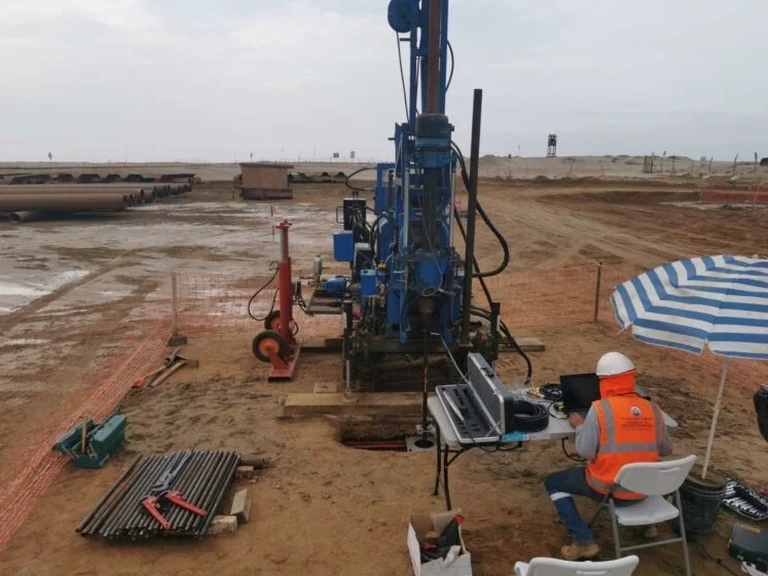
Technical reference image — Boston

Site-specific factors

One pattern we see repeatedly in Boston: a CPT refusal at 45 feet is interpreted as bedrock, but it is actually a large boulder embedded in till — and the real rock surface is another 20 feet down. Misreading that refusal can lead to pile tip elevations that fail under seismic loading. Our operators log penetration rate anomalies and excess pore pressure spikes that distinguish boulder hits from true top-of-rock, cross-checking against Massachusetts Geological Survey quadrangle maps and nearby boring logs. In the Back Bay and Leather District, where wood pile foundations from the 1800s still support occupied structures, we also watch for sudden drops in tip resistance that signal an old timber pile or buried granite block, preventing cone damage and ensuring the data remains clean for the liquefaction assessment that IBC Chapter 18 requires in Seismic Design Category D sites.

Need a geotechnical assessment?

Reply within 24h.

Email: contact@geotechnical-engineering.vip

Technical data

ParameterTypical value
Cone tip area10 cm² or 15 cm² per ASTM D5778
Penetration rate20 mm/sec ± 5 mm/sec
Sleeve friction resolution0.1 kPa, sampled at 1 cm intervals
Pore pressure transducerSaturated, de-aired, with 2 ms response time
Maximum push capacity20 tons (200 kN) on Boston glacial till
Data channels recordedqc, fs, u2, inclination, temperature
Soil behavior type chartRobertson (1990) with normalized parameters

Complementary services

01

Piezocone with Dissipation Testing

Full CPTu soundings with pore pressure dissipation at specified depths. We run dissipation tests in the Boston blue clay to estimate the coefficient of consolidation, which drives the settlement timeline for mat foundations and embankment preloading programs.

02

Seismic CPT for Vs Profiling

SCPTu with a downhole geophone array to measure shear wave velocity every 0.5 meters. This data directly determines the NEHRP site class and supports site-specific ground motion analyses required by the Boston Building Code for structures over 240 feet tall.

03

Rapid Site Screening for Wind Turbines

Multiple CPT soundings per day on coastal and offshore sites, including the waters off Hull and Deer Island, with real-time data transmission to the design team. We handle the logistics of barge-mounted and intertidal zone testing.

Relevant standards

ASTM D5778-20, IBC 2021 (Massachusetts amendments), FHWA Geotechnical Engineering Circular No. 5 (CPT guidelines), Robertson & Cabal (2015) soil classification, ASCE 7-22 for seismic site class determination

Questions and answers

How deep can a CPT rig push in Boston's glacial till?

Our 20-ton truck-mounted rig typically reaches refusal between 40 and 70 feet in the dense till that underlies much of the metro area. The exact depth depends on the till's overconsolidation ratio and the presence of cobbles or boulders. In the clay layers of Back Bay and the Seaport, we routinely push past 100 feet without refusal. We log the penetration rate and pore pressure response continuously to distinguish a boulder hit from true bedrock refusal, which prevents misinterpreting the bearing stratum elevation.

What does a CPT test cost for a typical Boston project?

For most site investigation programs in the Boston area, CPT soundings range from US$170 to US$280 per meter, with the final cost depending on mobilization distance, the number of soundings, and whether seismic or dissipation testing is included. A single day of testing with two soundings in downtown Boston generally falls between US$3,200 and US$5,500, including the engineering report with soil behavior type classification and geotechnical parameter correlations. We provide a fixed-price quote after reviewing the site location and depth requirements.

Can CPT replace soil borings for foundation design in Boston?

CPT provides continuous soil behavior data that standard borings with split-spoon sampling cannot match, particularly in the interbedded clays and silts of the Boston basin. However, CPT does not recover physical samples for laboratory testing, so we typically recommend combining CPT soundings with at least one soil boring to calibrate the cone data against index tests like Atterberg limits and grain size distribution. For deep foundation design in the metro area, this combined approach satisfies the subsurface investigation requirements of IBC Chapter 18 and provides the most reliable input for pile capacity analysis.
Location and service area

We serve projects across Boston and surrounding areas.

View larger map